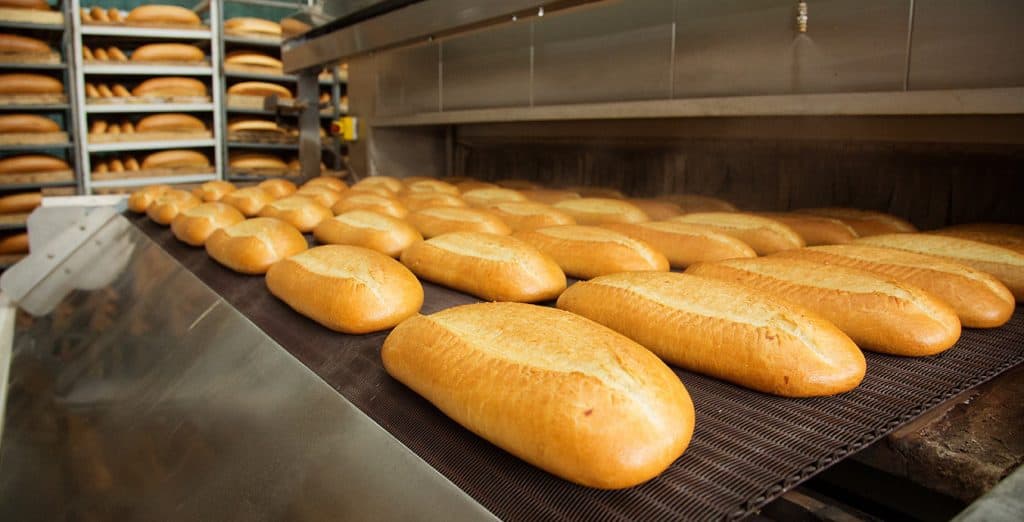
There are few industrial operations where the selection of lubricant is as crucial as it is when processing food products. Such oils need to be food safe in order for the resulting foodstuffs to be sold to the public, which is why we at Oil Store has carefully chosen a range of food safe lubricants and greases, produced by market leaders like Mobil and Fuchs, to suit every food production requirement.
Protective legislation exists to protect the public when it comes to food processing, which is why the very best food safe lubricants need to be appropriately certified where there is any chance of contact with food. Typically, the products we sell are NSF certified as well as NSF registered for use in food processing. The FLT Quality Standards are also borne in mind when formulating such lubricants.
Additionally, some lubricants are tailor made for use at extremely elevated temperatures, such as those found within food and beverage processing and packaging plants. Other food safe oils and greases include superb quality lubricants that are designed for use with the type of bearing, compressor, gear and hydraulic systems often found in food production factories.
Oil Store can supply just the right product for the food processing equipment and task involved, so you can order with confidence. Do make sure you get in touch if we can assist with your selection in any way.
What are food-safe lubricants?
Food-safe lubricants, sometimes referred to as food-grade lubricants, are solutions that have been specially formulated to have non-toxic properties. They are specifically designed for lubricating machinery used in operations where incidental contact with consumable products can occur, such as in the beverage, food and pharmaceutical manufacturing sectors.Key characteristics of food-safe lubricants
Featuring a clean formulation, food-safe lubricants are free from heavy metals such as arsenic and lead, as well as teratogens, mutagens and carcinogens. They are engineered to have no taste, colour or odour, so they do not alter the appearance, aroma or flavour of consumable products. Food-safe lubricants are also non-toxic and chemically stable to help ensure safety if trace amounts enter a production batch. To safeguard sensitive consumers, they are also designed without common dietary allergens. Applications for food-safe lubricants often demand durability and high performance. As such, they can withstand an extreme range of temperatures, from cold-storage freezers to high-heat ovens, without evaporating or breaking down. To cope with aggressive cleaning chemicals and processes such as steam sterilisation, which are used to keep workplaces hygienic, they can also resist moisture. As robust lubricants, they effectively reduce mechanical friction and help prevent rust, extending equipment lifespan. They are also compatible with multiple materials found in food-safe applications, such as rubber seals, plastics and elastomers.Classifications of food-safe lubricants
There are different food-safe classifications for different applications.H1 lubricants
These food-grade lubricants are used in food-processing operations where there is the potential for incidental food contact. To achieve H1 approval, lubricant manufacturers such as Fuchs or Klüber must demonstrate that all ingredients in the formulation are permitted substances.H2 lubricants
Suitable for use on machine parts and equipment in areas where no contact with food or food-related products is possible, these lubricants may also be used as release agents on machinery.H3 lubricants
Sometimes called soluble oils, these lubricants are used to clean equipment and combat corrosion and rust on items such as trolleys and meat hooks. While they are food-grade, they must be wiped off before the equipment is used.HT1 lubricants
A type of heat-transfer oil, this food-safe lubricant is used in both primary and secondary cooling and heating systems at food-processing facilities where incidental food contact is a risk.3H lubricants
These lubricants are release agents, typically vegetable oils, used on equipment where contact with food is inevitable, such as blades, plates and seals.