

06/11/2023 by Richard
A heat transfer fluid’s core function is to move thermal energy efficiently from one area of a mechanical system to another, with the aim of either heating or cooling in an industrial process or application. Heat transfer fluids, such as those provided by Paratherm, are liquid coolants, with water being the most affordable and effective option available. However, while offering benefits, water also has limitations as a heat transfer fluid. As a result, engineers have devised ways to improve its basic characteristics as well as formulating alternative fluids that can cope with more intense operating conditions.
Sought-after properties in a heat transfer fluid include system compatibility, high levels of thermal conductivity, low viscosity, specific heat, low freezing point, thermal stability, low toxicity, high flash point and low corrosivity. Below, we detail some of the best heat transfer fluid used for liquid cooling processes today. These include water and deionised water, dielectric fluids and inhibited solutions of glycol and water, but which is best will depend on your application.
Water
Among the best options for many liquid cooling applications water has high heat capacity and equally high thermal conductivity. It’s also compatible with one of the most effective heat transfer materials, copper. Water used in liquid cooling derives from various sources. For instance, tap water comes from public water treatment facilities or wells. The advantages of using tap water are availability and low cost.
What are the limitations of water as a heat transfer fluid?
Yap water is usually untreated and contains impurities. Such impurities can corrode cooling loops or block fluid channels. As a result, using quality water is advised to mitigate corrosion and optimise thermal performance.
How much water corrodes metal varies considerably according to chemical make-up. For instance, Chloride, which is corrosive is typically found in tap water. Tap water shouldn’t be utilised in liquid cooling loops when it contains over 25 Parts Per Million of chloride. Magnesium and calcium levels must also need to be considered, as they can create scale on metal parts, reducing their thermal performance.
How to manage impure water for heat transfer
When the tap water accessible contains high levels of impurities, salts, and minerals you can filter it or buy pre-filtered or deionized water instead. Even when water used is relatively pure and within recommended limits, adding a corrosion inhibitor like phosphate, tolyltriazole or sebacic acid is recommended for additional protection.
Deionised Water
An alternative heat transfer fluid is deionised water that has ions like sodium, iron, calcium, copper, bromide, and chloride removed. Deionisation effectively removes the harmful salts, minerals, and other impurities behind scale formation and corrosion. Compared to tap water, deionized water offers high resistivity. It is an exceptional insulator and is used by electrical components makers to electrically isolate components. However, as its resistivity rises, water’s corrosivity also increases. As a result, using a corrosion inhibitor is vital when water is extremely pure.
What are the important attributes of deionised water?
While tap water meets may liquid-cooling application requirements, deionised water has electrical and chemical properties make it the best option for cooling in liquid circuits with micro-channels and application using sensitive electronics.
Its exceptionally low ion concentration gives deionised water key performance characteristics. It eradicates mineral deposits that can block coolant flow that if left unchecked can reduce operating performance and cooling efficiency of the system. It also removes any risk of electrical arcing caused by static charge build-up from the coolant circulating. Arcing damages sensitive electronics in equipment. Removing ions from water mitigates both these issues.
Key considerations when using deionised water as a heat transfer fluid
Deionised water is often referred to as universal solvent as it is among the most destructive solvents identified. To a certain degree it can dissolve almost anything exposed to it. As a result, extreme care must always be taken when using it as a heat transfer fluid and all materials used to construct the cooling loop must be designed to be resistant to corrosion. Many materials are incompatible with deionised water, including copper which can contaminate it. Materials which can cope with the use of deionised water include nickel and steel.
What industries and application use deionised water for heat transfer?
Applications where deionised water is used as a liquid coolant include medical equipment, cosmetic food processing, pharmaceutical production, lasers, laboratory instrumentation, chemical process like plating and the manufacturing of semiconductors.
Systems cooled by deionised water are critical to the dependable operation of a diverse range of equipment types. Providing that systems are properly designed to work with deionised water and maintained correctly, they can supply dependable cooling as well as leak-free operation for an extended service period.
Dielectric fluid
Many specialised industries employ dielectric fluids as heat transfer fluids rather than water including those concerned with lasers, power electronics, and semiconductors. Dielectric fluids are non-conductive and as a result are the preferred choice over water when operation involve sensitive electronic systems.
Perfluorinated carbons, for example are non-flammable and non-explosive fluids that offer thermal stability over a broad range of operating temperatures. While deionised water is a non-conductive alternative, dielectrics are less corrosive making them a more suitable option for many applications. However, dielectrics are a more expensive option compared to deionised water.
Polyalphaolefin or PAO for short, is a synthetic hydrocarbon employed in many aerospace and military applications for the dielectric properties and wide operating temperature range it offers. For instance, fire control systems in modern military fighter planes are liquid cooled with PAO. While dielectric fluids can supply low risk heat transfer for sensitive electronics, they usually have a far lower thermal conductivity compared to water and water-based fluids.
Glycol and Water Solutions
The most common types of glycol-based solutions used in liquid cooling operations are propylene glycol and water or PGW for short and ethylene glycol and water (EGW). Ethylene glycol’s coveted thermal properties include its high boiling point, stability over a wide temperature range, low freezing point, thermal conductivity, and high specific heat. Additionally, it’s low viscosity reducing pumping requirements. While EGW has many sought-after physical attributes, PGW is more suitable in applications when toxicity is a concern. It is internationally recognised as safe for food processing applications and in food. It can even be used safely in an enclosed space.
Best practices and considerations for glycol solutions as heat transfer fluids
While EGW has a lower thermal conductivity than water it offers freeze protection that is beneficial in shipping and in use. Ethylene glycol is commonly used in automotive antifreeze, but this product should never be added to heat exchanger or cooling system as it includes silicate-based additives for rust inhibition. These additives can become a paste coating, exchanger surfaces and reducing efficiency but silicates can also reduce the service life of pump seals substantially. Although the wrong inhibitors can result in significant issues, the correct inhibitors can stop corrosion and prolong the lifespan of a cooling loop significantly.
When the concentration of glycol within liquid cooling solution increases the heat transfer fluid’s thermal performance decreases. As a result, the best practice is to always use the lowest possible concentration of glycol needed to meet the freeze and corrosion protection a system needs.
Die Wasserqualität spielt auch bei der Formulierung von Wärmeträgerflüssigkeiten auf Glykolbasis eine wichtige Rolle. Das Wasser muss bestimmte Grenzwerte einhalten oder unterschreiten, selbst bei Verwendung eines inhibierten Glykols. Ionen im Wasser können zum Verlust des Inhibitors führen, was wiederum Probleme wie Korrosion und Ablagerungen zur Folge haben kann.
Zugabe von Glykol zu flüssigen Kühlmitteln
In Umwälzkältemaschinen fließt flüssiges Kühlmittel, typischerweise Wasser, durch das System, um überschüssige Wärme abzuführen. Dabei steigt die Temperatur des Kühlmittels. Um seine optimale Kühlleistung zu erhalten, muss es durch den Wärmetauscher des Systems, den sogenannten Verdampfer, wieder auf die erforderliche Temperatur gebracht werden.
Es ermöglicht den Wärmeaustausch zwischen dem flüssigen Kühlmittel und dem Kältemittelgas im System. Die Temperatur des Kältemittels muss niedriger sein als die Temperatur des Kühlmittels, damit die Wärme effizient fließen und die Kühlmitteltemperatur effektiv auf den Sollwert zurückgeführt werden kann.
Das Kältemittel ist üblicherweise 5 bis 10 °C kälter als das Kühlmittel, um einen effektiven Wärmeaustausch zu gewährleisten. Fällt der Sollwert der Temperatur unter 10 °C, kann die Temperatur des Kältemittels den Gefrierpunkt von Wasser (0 °C) erreichen oder sogar unterschreiten. Gefriert das Kühlmittel, kann der Verdampfer des Systems verstopfen und den Wasserdurchfluss unterbrechen. Da sich Wasser beim Gefrieren ausdehnt, kann dies zu dauerhaften Schäden am Wärmetauscher führen.
Durch die Zugabe von Glykol zum Kühlmittel wird der Gefrierpunkt der Flüssigkeit auf etwa -34 °C gesenkt. Dadurch wird das Risiko von Frostschäden am Kühler wirksam minimiert.
Es ist wichtig zu beachten, dass Glykol Wärme nicht so effektiv überträgt wie reines Wasser. Daher ist es, wenn möglich, vorzuziehen, 100 % Wasser zu verwenden, sofern keine Frostgefahr besteht. Liegt die Solltemperatur des Systems jedoch unter 10 °C, besteht ein deutliches Frostrisiko, und die Betreiber sollten dem als Kühlmittel verwendeten Wasser Glykol beifügen. Der geringfügige Leistungsverlust ist ein notwendiger Kompromiss, der es ermöglicht, das System sicher mit einer niedrigeren Solltemperatur zu betreiben.
Alle aufgeführten Wärmeträgerflüssigkeiten können je nach Anwendung, Branche, Ausrüstung und Betriebsanforderungen die optimale Lösung darstellen. Es ist unerlässlich, die Kompatibilität der gewählten Wärmeträgerflüssigkeit mit Ihrem System, dessen Komponenten und den verwendeten Kältemitteln sicherzustellen. Konsultieren Sie vor dem Kauf eines Produkts den Originalgerätehersteller oder einen Schmierstoffexperten, um Schäden an Ihrem System und dessen Betrieb zu vermeiden.
Das könnte Sie auch interessieren:

Was ist Thermoöl?
Thermoöl, manchmal auch Wärmeträgerflüssigkeit (HTF) genannt, ist ein speziell entwickeltes Öl für industrielle Heizsysteme.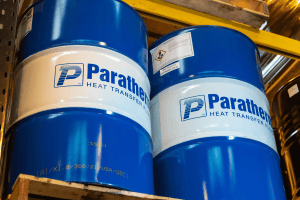
Eine Anleitung zur Verwendung von Paratherm NF zur Temperaturregelung
Paratherm NF ist eine Marke von CPI Fluid Engineering und ein lebensmittelgeeignetes Wärmeträgerfluid mit einem beeindruckenden Betriebstemperaturbereich von 332 °C bis -4 °C.