

07/05/2025 por Marca
Una marca de vanguardia de fluido de transferencia de calor (HTF), Paratherm is manufactured by Lubrizol’s CPI Fluid Engineering división.
Reconocida por su experiencia en la formulación y el suministro de una amplia selección de fluidos que funcionan a temperaturas extremadamente altas y bajas, ofrece HTF que ofrecen rendimiento, seguridad y eficiencia optimizados.
As a result, many operations using heat transfer systems often opt to update their current fluid selection to Paratherm. However, to benefit fully from what these advanced HTFs offer, it is essential that users clean and flush their system before making the switch.
En esta guía detallada, analizaremos más de cerca este proceso preparatorio, los pasos involucrados y los puntos clave a considerar.
Overview of switching fluido de transferencia de calor to Paratherm
Before making the move to using Paratherm, it is critical that the heat transfer system is cleaned and flushed. This process involves all old fluid, contaminants and debris being effectively removed. This is because any unwanted matter remaining in the system will negatively impact the active service life and performance levels of the new HTF.
Paratherm provides helpful guidance on how to prepare the system for its fluids that should always be followed closely for best results.
Evaluación
El primer paso es hacer que un profesional analice el fluido actual en el sistema de transferencia de calor. Una revisión experta de una muestra de HTF revelará el alcance de la contaminación del sistema y dictará la solución de limpieza adecuada a utilizar y la tasa de tratamiento adecuada.
Preparación
Antes de drenar el fluido existente del sistema, los operadores deben instalar un filtro en Y aguas arriba de la bomba. El filtro debe tener una malla de 60 que sea capaz de atrapar los desechos cuando el HTF gastado sale del sistema.
Siempre que sea posible, el fluido viejo del sistema debe calentarse a aproximadamente 107 °C. Esto reduce la viscosidad del fluido y ayuda a que los contaminantes permanezcan suspendidos durante el proceso de drenaje.
Ensure the pump is still running as the old HTF is drained from the system. This stops any particles that have settled from contaminating the fresh supply of Paratherm fluid.
Limpieza
With the system completely drained, cleaning can commence. Introduce the appropriate Paratherm cleaning agent. This may be Paratherm LC System Cleaner o Paratherm EC System Cleaner. Ambas son soluciones de limpieza patentadas específicamente formuladas para descomponer eficazmente los lodos y otros depósitos en los sistemas de transferencia de calor.
Los usuarios que introduzcan el limpiador del sistema deben añadirlo lentamente, con cuidado y según las instrucciones de uso. Mientras el sistema esté a la temperatura de funcionamiento, se debe permitir que la solución limpiadora circule durante el tiempo recomendado.
Durante el ciclo de limpieza, se requiere un monitoreo regular y es posible que sea necesario limpiar la pantalla del filtro en Y varias veces durante el proceso.
rubor
Una vez completado el ciclo de limpieza, se puede apagar el calentador del sistema. Sin embargo, la bomba debe seguir haciendo circular el limpiador hasta que el sistema se haya enfriado a una temperatura segura. Apague el calentador pero mantenga la bomba en circulación hasta que el sistema se enfríe a 93 °C o menos.
Under certain circumstances, like where the older fluid was fouled heavily o when the new HTF must operate at a substantially different temperature, operators should consider flushing the system with a charge of the brand-new Paratherm fluid o using a dedicated flushing fluid.
Recarga
With these stages complete, the heat transfer system is now ready to intake Paratherm. As with the cleaning agents, users should add the fresh supply of HTF slowly and carefully while meticulously following all product instructions.
The system can now be restarted. Operators must follow Paratherm’s recommended start-up procedures while monitoring for any indications of water contamination. These may include expansion tank geysers and pump cavitation.
Consideraciones adicionales
It is crucial that maintenance teams always ensure that the cleaning solution and flushing fluid are products compatible with the old HTF and the new Paratherm fluid. It is also important that those tasked with fluid changes avoid contaminating the system with water when cleaning and refilling. Any water introduced must be removed entirely before the system can see active use.
Siempre se deben seguir las instrucciones del fabricante de equipos originales (OEM) en cada paso del proceso. Finalmente, siempre que se manipule HTF y agentes de limpieza, se debe usar el equipo de protección personal (PPE) correcto para promover la salud y la seguridad en el sitio.
También te puede interesar:

¿Qué es el aceite térmico?
El aceite térmico, a veces denominado fluido de transferencia de calor (HTF), es un aceite especialmente diseñado para calefacción industrial.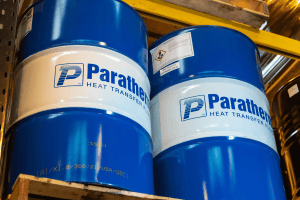
A guide to using Paratherm NF for temperature control
A CPI Fluid Engineering brand, Paratherm NF is a food grade fluido de transferencia de calor with an impressive operating range of 332 °C to -4 °C.