

12/04/2025 by Mark
Heat transfer fluids are crucial for many industrial processes; facilitating the efficient transfer of heat between the various components of a system.
Paratherm is one of the leading brands of heat transfer fluids. The company produces a line of specially formulated synthetic fluids designed for both industrial heating and cooling systems.
In this article, the mechanism of Paratherm heat transfer fluids will be discussed, looking closely at how they are used in closed-loop systems, their temperature control capabilities, their fluid properties and their various applications.
What are heat transfer fluids?
Heat transfer fluids are synthetic fluids used in industrial systems to transfer thermal energy between different components. They are used in systems that require heating or cooling, and ensure that temperature control is maintained within a specified range.
Paratherm heat transfer fluids are designed to be applied in closed-loop heat transfer systems where the fluid circulates continuously without interacting with the outside environment.
Heat transfer fluids come in various formulations designed for different temperature ranges. The fluids are thermally stable, handling high temperatures without breaking down, evaporating or degrading. They also contain heat transfer properties that make them ideal for precise temperature control in industrial environments.
Paratherm heat transfer fluids are a popular choice in many industrial sectors, being used in applications from chemical processing to food production and renewable energy.
Heat transfer mechanism
The core function of any heat transfer fluid is to transfer heat from one location to another. This is achieved through two primary heat transfer mechanisms: conduction and convection.
The process of conduction happens when heat is transferred through direct molecular interaction. When a heat source – a heated surface or a boiler, for instance – comes into contact with the heat transfer fluid, the thermal energy from the heat source is passed to the fluid molecules. As these molecules gain energy, their movement increases, and this raises the temperature of the fluid.
Convection occurs after the heat has been transferred to the fluid. The heated fluid circulates around the system; often using a pump to move the fluid through pipes, heat exchangers and other components. During this circulation, the fluid releases heat to cooler areas. This spreads the thermal energy evenly across the system.
Paratherm heat transfer fluids have unique formulations designed to offer high thermal conductivity. This provides more effective heat transfer, improving the efficiency of the system in which it is applied.
Closed-loop systems
Paratherm heat transfer fluids are usually used in closed-loop systems, in which the fluid continuously circulates through the system without significant loss or contamination. A closed-loop system allows for the fluid to be heated at one location and then circulated to absorb or release heat, depending on the requirements of the process requirements.
In these closed-loop systems, there is little evaporation or leakage of the heat transfer fluid. This helps to preserve the fluid’s thermal efficiency and reduces the need for frequent replenishment.
Temperature control
Heat transfer fluids allow industrial systems to maintain precise temperature control. Paratherm fluids are designed to operate across a broad temperature range – up to as high as 357°C in some formulations, depending on the specific formulation, and as low as -112°C.
It’s the careful control of the fluid’s circulation rate and the heat input or output that allows heat transfer fluids to regulate within a system. By adjusting the flow rate of the fluid or the heating element, engineers can fine-tune the system’s temperature so that it stays within the required range.
Fluid properties
The physical and chemical properties of heat transfer fluids is what make them effective.
These attributes include; thermal stability, remaining effective, without degrading, for extended periods, even under challenging operating conditions; low viscosity, meaning they flow easily through the system without requiring excessive pumping power; high heat capacity, enabling the absorption and storage of a high amount of heat without significant temperature fluctuations; and being non-toxic and biodegradable, which makes them safer for workers and the environment.
Applications
Paratherm heat transfer fluids are used in a variety of industrial applications.
These applications include, but are not exclusive to; alternative energy and emerging technologies; asphalt processing and storage; biofuel processing; chemical processing; engineered wood and building materials; extraction sciences; food (including meat and poultry) and beverage processing; industrial drying processes; oil and gas processing; pharmaceutical; and plastics, polymers, and textiles.
Integral to industrial systems
As discussed, Paratherm heat transfer fluids are integral to various industrial systems that require temperature regulation and heat management.
With their ability to transfer heat efficiently and maintain stable temperatures, this line of products looks set to remain in demand for a broad variety of industrial applications.
You may also interested in:

What is thermal oil?
Thermal oil, sometimes referred to as heat transfer fluid (HTF), is a specially engineered oil developed for industrial heating.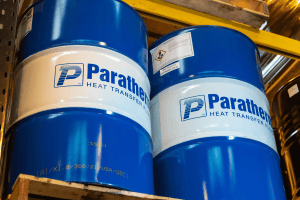
A guide to using Paratherm NF for temperature control
A CPI Fluid Engineering brand, Paratherm NF is a food grade heat transfer fluid with an impressive operating range of 332 °C to -4 °C.