

05/07/2025 by Mark
A cutting-edge brand of heat transfer fluid (HTF), Paratherm is manufactured by Lubrizol’s CPI Fluid Engineering division.
Renowned for its expertise in formulating and supplying a comprehensive selection of fluids that operate at extremely high and low temperatures, it offers HTFs that deliver optimised performance, safety and efficiency.
As a result, many operations using heat transfer systems often opt to update their current fluid selection to Paratherm. However, to benefit fully from what these advanced HTFs offer, it is essential that users clean and flush their system before making the switch.
In this detailed guide, we’ll take a closer look at this preparatory process, the steps involved and key points to consider.
Overview of switching heat transfer fluid to Paratherm
Before making the move to using Paratherm, it is critical that the heat transfer system is cleaned and flushed. This process involves all old fluid, contaminants and debris being effectively removed. This is because any unwanted matter remaining in the system will negatively impact the active service life and performance levels of the new HTF.
Paratherm provides helpful guidance on how to prepare the system for its fluids that should always be followed closely for best results.
Assessment
The first step is to have the current fluid in the heat transfer system professionally analysed. An expert review of an HTF sample will reveal the extent of the system fouling and dictate the proper cleaning solution to use and appropriate treatment rate.
Preparation
Before draining the existing fluid from the system, operators must fit a Y-strainer upstream from the pump. The strainer should have a 60-mesh screen that is capable of catching debris as the spent HTF leaves the system.
Where possible, the old fluid in the system should be heated to approximately 107 °C. This reduces the fluid’s viscosity and helps contaminants stay suspended during the draining process.
Ensure the pump is still running as the old HTF is drained from the system. This stops any particles that have settled from contaminating the fresh supply of Paratherm fluid.
Cleaning
With the system completely drained, cleaning can commence. Introduce the appropriate Paratherm cleaning agent. This may be Paratherm LC System Cleaner or Paratherm EC System Cleaner. Both are proprietary cleaning solutions specifically formulated to effectively break down sludge and other deposits in heat transfer systems.
Users introducing system cleaner should add it slowly, carefully and according to the usage instructions. While at system operating temperature, the cleaning solution should be allowed to circulate for the recommended duration.
During the cleaning cycle, regular monitoring is required, and the Y-strainer’s screen may need cleaning multiple times throughout the process.
Flushing
After the cleaning cycle is complete, the system heater can be shut down. However, the pump should remain circulating the cleaner until the system has cooled to a safe temperature. Turn off the heater but keep the pump circulating until the system cools to 93 °C or lower.
Under certain circumstances, like where the older fluid was fouled heavily or when the new HTF must operate at a substantially different temperature, operators should consider flushing the system with a charge of the brand-new Paratherm fluid or using a dedicated flushing fluid.
Refilling
With these stages complete, the heat transfer system is now ready to intake Paratherm. As with the cleaning agents, users should add the fresh supply of HTF slowly and carefully while meticulously following all product instructions.
The system can now be restarted. Operators must follow Paratherm’s recommended start-up procedures while monitoring for any indications of water contamination. These may include expansion tank geysers and pump cavitation.
Further considerations
It is crucial that maintenance teams always ensure that the cleaning solution and flushing fluid are products compatible with the old HTF and the new Paratherm fluid. It is also important that those tasked with fluid changes avoid contaminating the system with water when cleaning and refilling. Any water introduced must be removed entirely before the system can see active use.
Original equipment manufacturer (OEM) guidance should always be adhered to at every step of the process. Finally, whenever handling HTFs and cleaning agents, correct personal protective equipment (PPE) should be worn to promote health and safety onsite.
You may also interested in:

What is thermal oil?
Thermal oil, sometimes referred to as heat transfer fluid (HTF), is a specially engineered oil developed for industrial heating.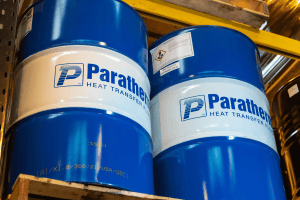
A guide to using Paratherm NF for temperature control
A CPI Fluid Engineering brand, Paratherm NF is a food grade heat transfer fluid with an impressive operating range of 332 °C to -4 °C.